Solexa technology
(sequencing-by-synthesis)
Sample preparation.
Fragments of DNA are ligated to end adapters,
denatured and bound at one end to a solid surface
already coated with a dense layer of the adapters. Each single stranded
fragment is immobilized at one end, while
its free end ‘bends over’ and hybridizes to a complementary adapter
on the surface, which initiates the synthesis of the complementary strand in
the presence of amplification
reagents. Multiple cycles of this solid-phase amplification followed by
denaturation create clusters of ~1,000 copies of single-stranded DNA molecules
distributed randomly on the surface.
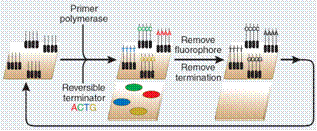
Sequencing with reversible terminators.
Synthesis reagents, added to the flow cell,
consist of primers, DNA polymerase and four differently
labeled, reversible terminator nucleotides. After incorporation of a
nucleotide, which is identified by its color,
the 3′
terminator on the base and the fluorophore are removed, and the
cycle is repeated for a read length of 30–35 nucleotides.