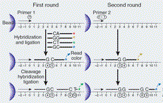
SOLiD technology
(sequencing-by-ligation)
Sample preparation.
Fragments of DNA are ligated to adapters and
amplified on beads by emulsion PCR. The DNA
is denatured and the beads deposited onto a glass slide.
Sequencing by ligation.
A sequencing primer is hybridized to the adapter
and its 5' end is available for ligation to an oligonucleotide
hybridizing to the adjacent sequence. A mixture of octamer oligonucleotides compete
for ligation to the primer (the bases in fourth and fifth position on these
oligos are encoded by one of four color
labels). After its color has been recorded, the ligated oligonucleotide
is cleaved between position 5 and 6, which removes the label, and the cycle of
ligation-cleavage is repeated. In the first round, the process determines
possible identities of bases in positions 4, 5, 9, 10, 14, 15, etc. The
entire process is repeated, offset by one base
by using a shorter sequencing primer, to determine positions 3, 4, 8, 9, 13,
14, etc., until the first base in the
sequencing primer (position 0) is reached. Since the identity of this base
is known, the color is used to decode its neighboring base at position 1,
which in turn decodes the base at position
2, etc., until all sequence pairs are identified. The current read length
is between 30 and 35 nucleotides