|
|
|
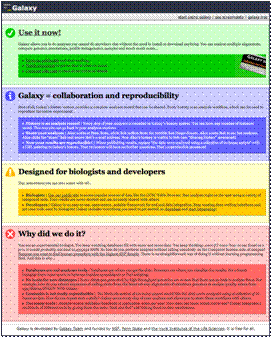
If you go to the URL
shown here, you will find a short introduction to Galaxy.
|
|
|
|
We’ll start at the
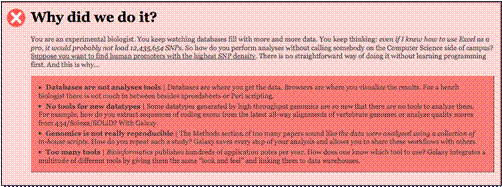
bottom of the page, since this is where we will learn what Galaxy is. In the
red section at the bottom, you will learn the rationale for Galaxy. Galaxy is
not a database, but rather it is an analysis tool. The amount of data and
number of databases is increasing exponentially, but the tools available to
analyze this data are small in number and have a difficult time keeping up
with new data types. Galaxy aims to provide an analysis resource that allows
the user to pull data from many different databases and analyze that data. It
also aims to give the user a way to reproduce and share that analysis. Galaxy
integrates many databases and analysis tools and is continually growing and
evolving.
|
|
|
|
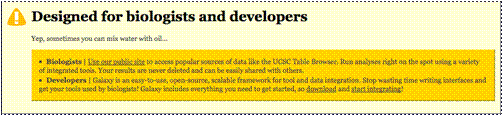
The Galaxy tool was
created for both bench scientists to have a relatively simple tool to use to
do data analysis, and for the bioinformatics developer to integrate tools and
analyses for the user. This tutorial is aimed at that first group of users,
the biologists who wish to perform data analysis, but developers might find
it useful. We also suggest that developers view the FAQs and screencasts for
more information on how to integrate your tools into the Galaxy framework.
|
|
|
|
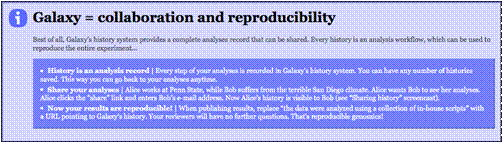
This integration of
databases, tools and workflows allows for the ability to collaborate between
scientists and between scientists and developers. This also allows
researchers to share their analysis and for other researcher to reproduce
their analysis where otherwise they might not have.
|
|
|
|
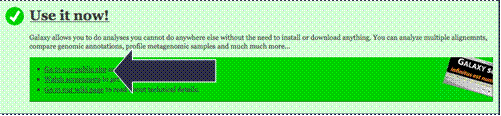
The website is
available for anyone to use right now if you click the link to go to the
public site.
|