454 technology
(Pyrosequencing)
Sample preparation.
Fragments of DNA are ligated to adapters that
facilitate their capture on beads (one fragment per
bead). A water-in-oil emulsion containing PCR reagents and one bead per
droplet is created to amplify each
fragment individually in its droplet. After amplification, the emulsion is broken,
DNA is denatured and the beads, containing one amplified DNA fragment each,
are distributed into the wells of
a fiber-optic slide.
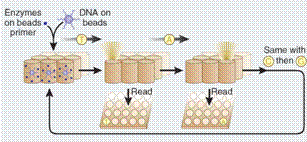
Pyrosequencing.
The wells are loaded with sequencing enzymes and
primer (complementary to the adapter on the
fragment ends), then exposed to a flow of one unlabeled nucleotide at a time,
allowing synthesis of the complementary
strand of DNA to proceed. When a nucleotide is incorporated, pyrophosphate
is released and converted to ATP, which fuels the luciferase-driven conversion
of luciferin to oxyluciferin and light. As a
result, the well lights up. The read length is between 100
and 150 nucleotides.