

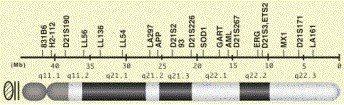
Chromosome 21 is the smallest human
chromosome. Three copies of this autosome cause Down syndrome, the most frequent genetic
disorder associated with significant mental retardation. Given the serious effects and
frequency of this disease chromosome 21 has gained a prominent position in biomedical
research. Five years ago, in the framework of the international human genome project, and
as an integrated part of the chromosome 21 community, we have formed a consortium of
academic groups from Germany and Japan to map and sequence this chromosome. A total of
33,546,361 bp of DNA, distributed over four contigs, were sequenced with very high
accuracy. The largest of these contigs is 25,491,867 bp long. Only three small clone
gaps remain, which together comprise approximately 100 kb. Thus, we achieved a
coverage of 99.7% of 21q. In addition, 281,116 bp from the short arm were also sequenced.
Analysis of the chromosome revealed 127 known genes, 98 predicted genes, and 59
pseudogenes. The completion of the 21q sequence now provides a unique resource for
understanding the molecular pathophysiology of Down syndrome, as well as all other monogenic
and complex disorders that map to this chromosome. It also stands as a structural
framework from which the complete molecular architecture of the chromosome can be
determined.
Nature
May 18, 2000