| |
SARS: The Disease And The
Virus |
In late 2002, an outbreak of severe, atypical pneumonia was reported in
Guangdong Province of China. The disease had an extremely high mortality rate
(currently up to 15-19%), and quickly expanded to over 25 countries. The World
Health Organization coined it "severe acute respiratory syndrome", or SARS. In
April 2003, a previously unknown coronavirus was isolated from patients and
subsequenly proven to be the causative agent according to Koch's postulates in
experiments on monkeys. The virus has been named SARS coronavirus (SARS-CoV)
The first complete sequence of SARS coronanirus was obtained in BCCA Genome
Sciences Centre, Canada, about two weeks after the virus was detected in SARS
patients. It was immediately submitted to GenBank prior to publication as a raw
nucleotide sequence. GenBank released the sequence to the public the same day
under accession number
AY274119; the NCBI Viral Genomes Group annotated the sequence also the same
day and released it in the form of the Entrez Genomes RefSeq record
NC_004718 at 2 am next day. As of the beginning of May, all the SARS-CoV RNA
transcripts have been detected and sequenced in at least two laboratories;
further experiments are underway.
The availability of the sequence data and functional dissection of the
SARS-CoV genome is the first step towards developing diagnostic tests, antiviral
agents, and vaccines.
This web resource provides data and information relevant to SARS coronavirus.
It includes links to the most recent sequence data and publications, results of
pre-computed sequence analysis:
genomic,
protein, 3-D structure.
Links are provided to other SARS related resources.
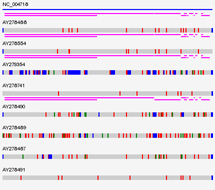 |
The genome of SARS-CoV consists of a single giant
positive-strand RNA that is approximately 29,700 nucleotides long. View
pre-computed global alignment of genomes
from various isolates.
The overall genome organization
of SARS-CoV is similar to that of other coronaviruses. Two large overlapping
coding frames (ORFs) encompass 71% of the genome. The 3'-adjacent remainder
has 12 potential ORFs. These include genes for structural proteins S
(spike), E (small envelope), M (membrane), and N (nucleocapsid). Other
potential ORFs code for unique putative SARS-CoV-specific polypeptides that
lack obvious sequence similarity to known proteins.
|