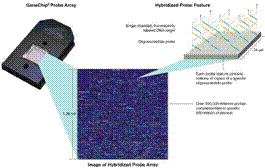
•Oligonucleotides
–usually at least 20–25 bases in length, optimal
with 45~60 bps long
–10–20 different
oligonucleotides for each gene
•Oligonucleotides for each gene selected by computer program to be the
following:
–unique in genome (4 (20 to 25) =2(40 to 50) >> 3*109 = 230), not likely to appear twice
–non-overlapping (if the sequence length is too short then specificity is low, whereas
if the length is too
long, self-hybridization could happen)
•Composition based on design rules
–empirically derived
rules
(ratio of G-C pairs vs. A-T pairs which
could affect the melting temperature
of the seq., ie. Tm = 64.9+0.41*(GC%)
-675/L)
Oligonucleotide
microarrays – pioneered by Affymetrix