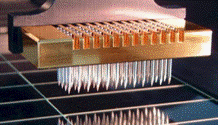
üInk-jet printhead draws up DNA Ink-jet printer microarrays
üPrinthead moves to specific location on solid support
üDNA ejected through small hole
üUsed to spot DNA or synthesize oligonucleotides directly on glass slide
üUse pioneered by Agilent Technologies, Inc.
Ink-jet printer microarrays
pgs2e-fig-04-06-2
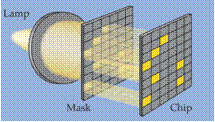
Photolithography
üLight-activated chemical reaction
•For addition of bases to growing oligonucleotide
üCustom masks 
•Prevent light from reaching spots where bases not wanted
üMirrors also used
•NimbleGen™ uses this approach
ü
Another method for depositing DNA on glass slides is the use of ink-jet printer technology. Ink-jet printers are designed to deposit very small quantities of ink in precise locations. As adapted for microarray spotting, the printhead draws up a small amount of DNA, moves to a particular point on the slide, and ejects the DNA through a very small hole. This technology has also been adapted to provide for the synthesis of oligonucleotides on slides. After each base is added through the printhead to the growing oligonucleotide, the slide is washed free of excess nucleotides, and the exposed bases are primed for the addition of the next nucleotide. Agilent Technologies has pioneered the use of ink-jet printing for making microarrays. The primary drawback of this approach as compared with photolithography is that the maximum number of spots on a slide is far fewer with the ink-jet printing of DNA.